
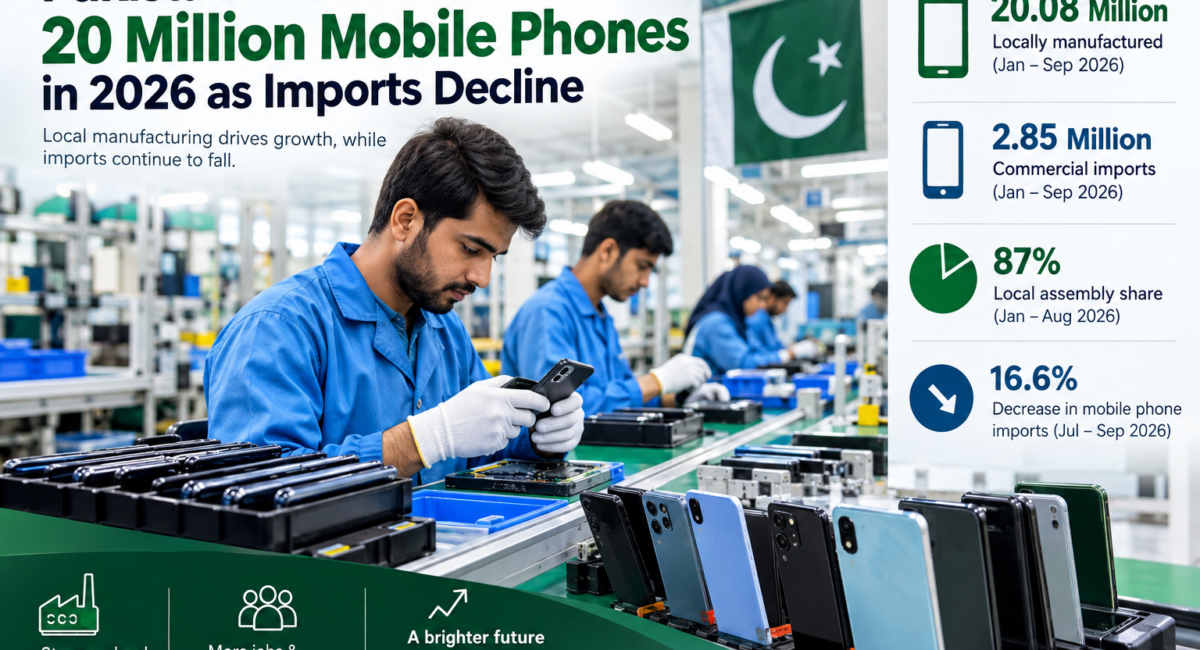
Pakistan produces over 20 million mobile phones in 2026
Pakistan produces over 20 million mobile phones in 2026
From January to September 2026, Pakistan’s mobile phone manufacturing and assembly industry produced over 20 million mobile phones. The latest figures show that local manufacturing and assembly totalled 20.08 million units. Whereas commercially imported devices totalled 2.85 million.
While the latest figures show that the country still heavily relies on locally manufactured mobile phones, there are still some issues which need to be overcome such as production not being consistent month on month, reliance on imported parts and increasing affordable smartphone manufacturing.
Pakistan Produces Over 20 Million Mobile Phones
Approximately 20.08 million mobile phones were manufactured and assembled locally throughout January to September 2026. Of these, around 8 million are smartphones and 12 million are 2G feature phones.
These figures show that basic phones are still a large part of the domestic market.
Throughout 2025, 30.21 million mobile phones were manufactured and assembled locally, whereas commercially imported devices totalled 2.37 million. However, the latest statistics only cover January to September 2026.
By increasing local assembly, Pakistan has built up a larger supply chain with locally made devices.
Most Mobile Phones Sourced Locally
Pakistan’s local assembly industry is now the main source of devices entering the country through local manufacturing and commercial imports.
Between January and August 2026, 18.66 million units were assembled locally, compared to 2.74 million imported commercially. This means locally assembled devices accounted for roughly 87%.
These figures do not represent total sales of devices however, or what percentage of all phones in use are from Pakistan.
Thanks to the large amount of locally assembled devices, the country is becoming increasingly capable of providing popular models without relying on imports.
Smartphones and Feature Phones
Pakistan provides a mixture of advanced smartphones and affordable feature phones.
Around 8 million smartphones and 12 million 2G handheld devices were assembled locally between January and September 2026. As mentioned above, feature phones are very important for those wanting a cheaper phone for making calls and sending texts.
Recent reports have shown that smartphones make up around 71% of mobile devices in use in Pakistan, according to data from the Pakistan Telecommunication Authority. 29% of devices are 2G.
This can provide opportunities for companies to increase affordable smartphone manufacturing.
Import Value Down
The country has also seen a decrease in the value of imported mobile phones during the first quarter of 2026/27.
The latest figures show that during the same period last year, they totalled around $417.24 million during July-September 2026, down 16.6% from around $500.01 million.
In Pakistani rupees this totalled Rs116.01 billion, down from Rs141.42 billion during the same period last year. This is a decrease of around 18%.
Imports did increase from August to September however. In August, the total increased to $143.14 million from $133.66 million in dollar value. However, this was still less than September 2025.
While the total value of imports has decreased, this won’t necessarily mean that the country is no longer reliant on imports for some parts of their mobile phones.
Increasing Competition from Local Brands
There are many local brands manufacturing and assembling mobile phones in Pakistan alongside international smartphone brands.
The latest figures show that VGO TEL produced the most devices during January to September 2026 by assembling approximately 2.50 million. Infinix came second with around 1.96 million. Itel assembled approximately 1.59 million.
TECNO came fourth with around 1.16 million. Samsung came fifth with around 1.04 million and vivo with 990 thousand.
These figures represent total phones assembled and manufactured. They do not include just smartphones.
Having many international brands manufacturing phones in Pakistan shows there is potential to invest into the industry, improving manufacturing capabilities and increasing the range of locally assembled devices.
Issues with Pakistan’s Mobile Phone Industry
Despite an increase in total manufacturing, there are still several issues to overcome.
One issue is the reliance on imported parts. While local assembly can reduce reliance on imported devices, companies may still require imported parts, electronics and more.
Affordability of smartphones can also be an issue. Taxes, exchange rates, manufacturing costs and customers’ disposable income can all impact demand for newer devices.
The industry needs to increase manufacturing of modern 4G and 5G smartphones. While they have millions of devices being locally assembled, they still produce a large amount of feature phones.
Investing in manufacturing technology and creating a stronger supply chain will also be key for long term growth.
Looking Ahead
Pakistan have seen a huge increase in their manufacturing industry. A large amount of devices are being supplied by local manufacturing and commercial imports.
The government is also working on a new policy to boost local manufacturing. The Mobile and Electronic Devices Manufacturing Policy (2026-2033). This aims to increase local manufacturing, invest into the industry and encourage technology transfer.
If these efforts result in increased depth of manufacturing, Pakistan could create more skilled jobs, build up local suppliers for parts and boost competition.
For customers, having a stronger local manufacturing industry could increase availability of devices and competition. However, the actual impact to retail prices will depend on manufacturing costs, taxes, exchange rates and demand.
Conclusion
During January to September 2026, Pakistan manufactured 20.08 million mobile phones. Commercial imports totaled 2.85 million. The latest figures highlight the importance of local assembly.
The industry needs to overcome issues surrounding reliance on imported parts, increasing affordability of smartphones and increasing manufacturing of advanced devices.
The next step is to increase not only how many devices are being assembled locally, but also how much technology, investment and value can be created within their manufacturing industry.
Leave a Comment